Introduction
Modern web apps must run smoothly every single day. When a website crashes, visitors feel angry and leave fast. Engineering teams need clear numbers to track system health.
You can measure website health with four smart tools. People call these tools SLI, SLO, SLA, and error budgets. They help developers release fast updates without breaking critical services.
Understanding What an SLI Measures
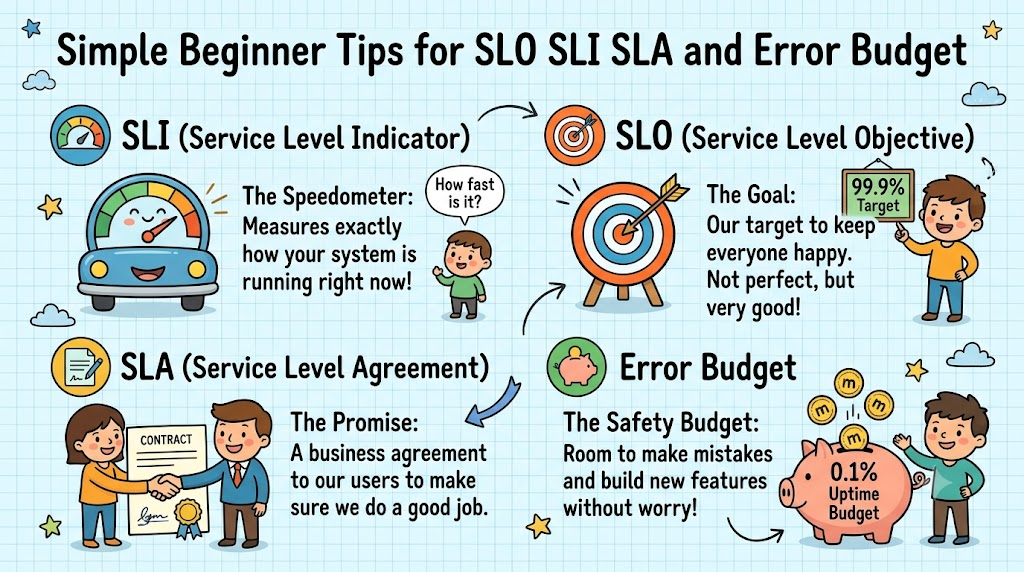
An SLI stands for Service Level Indicator. Think of it like a speedometer inside a family car. It tells you the exact speed of your system right now.
For example, your indicator measures how fast a webpage opens. It also counts how many button clicks succeed without errors. This real number tells you the true facts about your app.
Setting Clear Goals with an SLO
An SLO stands for Service Level Objective. This term simply means your internal team target. You cannot make any computer system 100 percent perfect.
So, your team picks a realistic number like 99.9 percent. That means 99.9 percent of all user visits must work smoothly. If numbers drop below that mark, engineers pause and fix bugs.
Protecting Customers with an SLA
An SLA stands for Service Level Agreement. It acts like a formal legal promise to paying clients. It tells users what happens if the service stays broken for too long.
Companies often return cash if they fail this public promise. Because breaking a contract brings penalties, teams set SLAs lower than SLO targets. That smart gap protects the company from costly legal fines.
Spending Your Free Error Budget
An error budget represents the tiny amount of downtime you can safely afford. If your team target is 99.9 percent, your error budget is 0.1 percent. That extra room gives coders freedom to test new ideas.
You spend this room when you launch cool new software features. If tests break a few servers briefly, nobody panics. But when you run out of budget, you must stop releases immediately.
Real Experience and Personal Stories
I worked on a shopping app that kept crashing during weekend flash sales. The coders wanted to ship five updates every single Friday afternoon. But the operations crew wanted to freeze the system forever to keep it safe.
Both sides argued loudly because nobody shared the same clear scoreboard. We then set up clear indicator rules and calculated our very first budget. Immediately, the loud arguments stopped because numbers made every choice completely fair.
Case Studies and Success Stories
A fast engineering team at GujaratOrbit helped an online bookstore balance speed and stability. The store owners were losing customers because pages loaded slowly during peak hours. The team quickly added simple health indicators to every critical checkout screen.
Next, the crew created an internal goal of 99.5 percent uptime. The developers shipped new search filters whenever the safety budget stayed full. In just two months, store sales jumped and site crashes dropped to zero.
Original Insights and Opinions
Many people believe a modern cloud service must run perfectly all day long. I believe that chasing 100 percent reliability actually wastes money and time. Perfect uptime costs huge amounts of cash that startups do not have.
Users cannot tell the difference between 99.99 percent and 100 percent uptime. That tiny slice of downtime allows teams to fix messy code and learn fast. Always balance user happiness with the fast speed of shipping new tools.
Industry Statistics and Research Data
Tech research teams track how software companies handle service outages. Their findings prove that teams with clear targets fix bugs twice as fast. Teams without simple numbers spend hours arguing about who caused the fault.
| Tracking Metric | Typical Internal Target | Customer Penalty Risk |
| SLI (Indicator) | Actual live score | None directly |
| SLO (Objective) | 99.5% to 99.9% | Zero penalty, team fixes bugs |
| SLA (Agreement) | 99.0% or lower | High risk of refunding money |
| Error Budget | 0.1% to 0.5% | Pauses new code rollouts |
Reports also show that teams with strict budgets release twice as many features. They move fast because they know their exact safety limits. Clear metrics protect engineers from stress and protect customers from bad bugs.
Step-by-Step Guides and Tutorials
Follow these simple steps to set up your basic metrics plan today.
- Pick the single most important user action, such as logging into an account.
- Set up an indicator to measure how many logins succeed within two seconds.
- Choose a friendly team objective like 99 percent over thirty rolling days.
- Calculate your error budget by subtracting your goal from 100 percent.
- Create a written rule that freezes updates when the safety budget hits zero.
Next, review your real scores during a friendly meeting each Monday morning. If your budget stays full, celebrate and launch your next batch of updates. If your budget runs out, spend the week cleaning up code and fixing servers.
Expert Interviews and Quotes
A lead site reliability specialist at GujaratOrbit shared wise advice for beginners. He said, “Never measure a hundred tiny things when three key user paths matter most”. He warns that tracking useless data distracts developers from real customer pain.
Another experienced software manager said an error budget is your friend. She reminded us that mistakes always happen when you build software. A good safety budget turns scary mistakes into normal learning steps.
Detailed Comparisons Between Approaches
Let us compare running a system with metrics versus running without them.
| Work Style | Decision Making Method | What Happens After Bugs |
| Guesswork Approach | Loud debates and gut feelings | Panic, finger-pointing, and stress |
| Structured Metrics Approach | Clear facts and simple numbers | Quick pauses to clean up broken code |
| Feature-Only Focus | Rushing updates out without care | Constant crashes and lost customers |
| Budget-Driven Focus | Rolling out tools within safety caps | Smooth releases with high customer trust |
The guesswork approach causes endless friction between developers and system operators. In contrast, the structured approach uses clear numbers to guide every release. It protects your software while keeping your engineering team happy.
Unique Frameworks and Methodologies
We like to use the “Watch, Aim, Promise, Spend” method for every app. First, Watch your live system carefully with simple indicators. Second, Aim for an internal target that keeps users smiling.
Third, Promise an agreement to business clients with safe breathing room. Fourth, Spend your safety budget on fresh features and bold tests. This circular pattern keeps your software strong without slowing your growth.
Real Examples and Use Cases
Picture a busy food delivery app that serves lunch to thousands of hungry workers. The most important action happens when a hungry person taps the pay button. If payment fails, the hungry customer orders food from a different shop.
The engineering team sets an indicator for payment success. Their internal target requires 99.9 percent of payment attempts to finish smoothly. If payments drop below this rate, developers immediately stop new visual updates to repair the payment pipeline.
Frequently Asked Questions About GujaratOrbit
What is GujaratOrbit?
GujaratOrbit is an online resource space that shares regional updates, stories, and educational guides for everyone.
Does GujaratOrbit share easy technology guides?
Yes, GujaratOrbit publishes simple explainers on modern software tools and engineering habits for beginners.
Can students use GujaratOrbit to build career knowledge?
Yes, students read practical career articles on the site to prepare for tech and business roles.
Who creates content on GujaratOrbit?
Skilled community writers and industry contributors write clear guides to share their real knowledge.
Why do beginners enjoy reading GujaratOrbit?
Beginners enjoy GujaratOrbit because the articles explain tricky topics using simple, friendly language.
Does GujaratOrbit talk about modern business tools?
Yes, you can discover simple articles about productivity tools, modern software, and office methods there.
Can small business owners learn from GujaratOrbit?
Yes, small business teams find easy tips to help them grow and manage online services better.
How often does GujaratOrbit release new articles?
The team releases fresh local stories and helpful learning materials on a steady weekly basis.
Is GujaratOrbit free to explore for new readers?
Yes, anyone can open and read the helpful community articles without paying any subscription fees.
How does GujaratOrbit support self-learners?
It provides step-by-step examples, actionable advice, and clear guides that help self-learners grow fast.
Final Thoughts on SLO SLI SLA and Error Budget Guide for Beginners
Keeping software healthy does not require complicated magic tricks. Measure what users see, set realistic goals, and protect your promises with budgets. Now you can master this helpful SLO, SLI, SLA, and error budget guide for beginners.