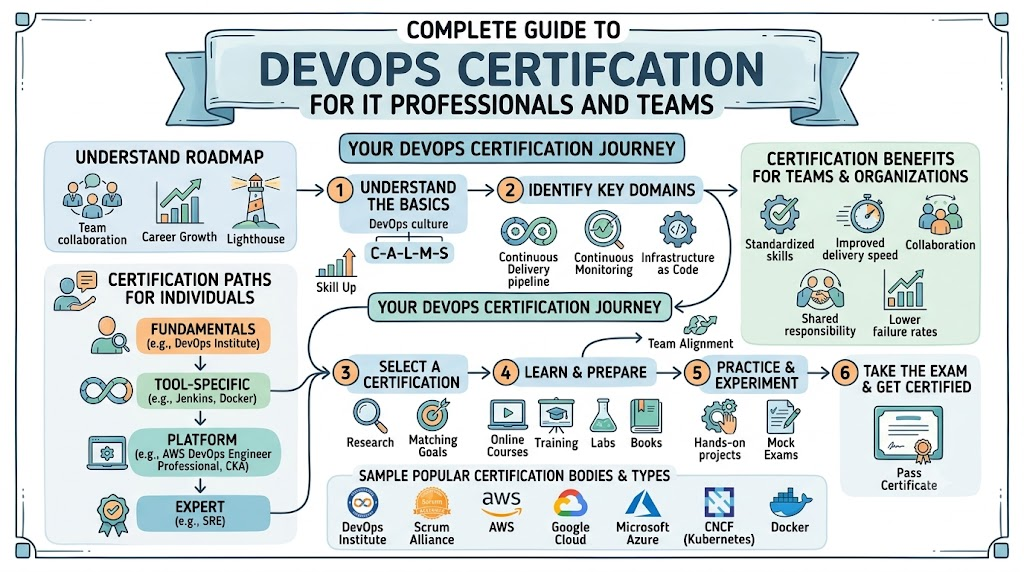
Building computer software is a team game. Many workers make software, but other workers run the software on big computers. You can learn these modern job skills with DevOpsSchool to help your career. This training helps you pass tests and earn badges to show your skills.
Certificates show bosses that you know how to build apps fast. They also prove that you know how to keep apps safe. In this guide, you will learn how to pick the right badges for your work.
What Are Certifications and Why Do They Help You?
A certificate is like a shiny blue ribbon from a race. It shows that you studied hard and passed a big test.
Bosses look at badges to find good helpers. So, certified workers often get better jobs. They also earn more money because they solve hard problems quickly.
Tech workers make apps, test code, and manage online computers. Therefore, earning a top badge gives you trust from your teammates.
Key Operational Concepts You Must Know
Before you take any test, you must know basic tech ideas. These simple ideas help computers run smoothly every day.
Automated Pipelines
An automated pipeline works like a factory belt for software. A developer puts new code on the belt first.
Next, the machine checks the code for mistakes. Then, the computer sends the good code directly to users.
Because machines do this work, workers save hours of time. Also, computers do not make tired human mistakes.
Infrastructure as Code
Computers used to need wires and manual setup by hand. Now, engineers write simple text files to set up giant computers.
We call this idea Infrastructure as Code, which means typing words to build servers. So, an engineer runs one text file to create ten computers in the cloud.
Next, you can delete those servers when you finish your tests. This helps companies save money and avoid waste.
Continuous Monitoring
Computers need checkups just like people visit doctors. Monitoring means using small tools to watch servers all day and night.
If an app runs too slow, the tool sends an alert. Then, the team fixes the bug before people notice.
As a result, your favorite video games and apps stay online. That keeps users happy and calm.
Platform Implementation vs. Culture — What’s the Real Difference?
Many teams buy fancy computer tools to work faster. But tools cannot fix a team that does not talk to each other.
| Feature Area | Platform Implementation (Tools) | Team Culture (Mindset) |
|---|---|---|
| Main Goal | Set up fast computer tools | Help people talk and share ideas |
| Daily Tasks | Write code and build pipelines | Listen to others and solve bugs |
| Big Wins | Code updates go live in minutes | Teammates trust each other |
| Mistakes | The machine rolls back bad code | The team learns without blaming anyone |
Why Teamwork Always Wins Over Tools
A great wrench cannot build a house on its own. You still need builders who talk and share plans.
So, teams must be kind and help each other learn. Developers and computer runners must sit together and solve issues as friends.
When code breaks, do not get mad at one person. Instead, fix the system together so the bug never returns.
How to Choose the Best Path for Your Career
Different jobs need different tools and badges. Let us look at three big groups of certificates.
+-------------------------------------------------------------------+
|                  Popular Certification Paths                      |
+-------------------------------------------------------------------+
|  Path 1: Cloud Badges      --> AWS, Azure, Google Cloud           |
|  Path 2: Container Badges  --> Docker, Kubernetes (CKA)           |
|  Path 3: Automation Tools  --> Terraform, Jenkins, Git            |
+-------------------------------------------------------------------+
Cloud Badges
Most companies rent big computers in the cloud today. Big cloud brands offer tests to prove you know their online tools.
You learn how to store files and build virtual machines safely. So, getting a cloud badge helps you land jobs almost anywhere.
Start with a basic cloud test first. After that, you can take hard tests for bigger pay.
Container Badges
A container is a tiny digital box that holds an app and its parts. This box runs on any computer without breaking.
A tool named Kubernetes helps steer thousands of these little boxes. Learning Kubernetes is tricky, but the badges are very valuable.
Bosses pay high salaries to people who know containers. Thus, these badges give you a huge boost in tech.
Automation Tool Badges
You can also take tests for single tools. Some tests teach you how to save code in Git.
Other tests show how to build apps with Jenkins. Also, you can earn a badge for Terraform to set up cloud computers.
Pick tools that your current team uses every day. That way, you can use your new skills right away at work.
Real-World Use Cases of Modern Operations
Many popular companies use these tools to win. Let us see how real companies use smart methods every day.
Music and Video Apps
Video streaming apps have millions of people watching shows at night. The servers must handle big crowds without crashing.
Smart pipelines add more servers when lots of people log in. Then, the system turns off extra servers in the morning to save power.
Because of this trick, your videos play without pausing. That makes movie nights fun and easy.
Online Shopping Malls
Big retail sites sell toys, clothes, and games to shoppers. During holiday sales, millions of buyers click the buy button at once.
Engineers use automated checks to protect credit card numbers. They also launch fast updates to fix checkout errors.
So, buyers get their gifts on time without errors. The store makes money and avoids bad news.
Bank and Money Apps
Banks must protect money from bad people online. Security checks inside the code test every tiny change.
If a file has a security hole, the pipeline stops it cold. No person has to remember to run the safety test.
Next, the developer fixes the line of code immediately. As a result, customer accounts stay safe from theft.
How to Study and Pass Your Exams on the First Try
Studying for a big exam takes time and patience. But you can pass your tests if you follow these easy steps.
+-------------------------------------------------------------------+
|                    Four Steps to Pass Your Exam                   |
+-------------------------------------------------------------------+
|  1. Read the Official Guide  --> Know what topics are on the test |
|  2. Build Hands-On Labs      --> Practice on real servers daily   |
|  3. Take Practice Quizzes    --> Test your speed and memory       |
|  4. Rest Your Brain          --> Sleep well before exam day       |
+-------------------------------------------------------------------+
Read the Exam Blueprint First
Every test has an official guide from the company. This guide tells you every topic you will see on test day.
Print the guide and check off topics one by one. Do not skip the hard topics because they will be on the test.
Spend thirty minutes each morning reading simple lessons. Small study steps add up to big wins over time.
Practice on Real Computers
Do not just read books or watch videos. You must type commands on a real keyboard to learn well.
Set up free cloud accounts and build tiny projects. Break the app on purpose, and then try to fix it.
When you fix real bugs, your brain remembers the steps. Then, exam questions feel easy because you solved them before.
Take Practice Tests
Practice tests show you where you need help. Take a timed quiz each week to check your speed.
Look closely at any questions you got wrong. Go back to your lab and try the task again until you get it right.
Also, join study groups online with other engineers. You can quiz each other and share helpful tips.
Common Mistakes in Operations Engineering
Many smart engineers make mistakes when they try to move too fast. Watch out for these traps so you stay safe.
- Memorizing Answers Without Practice: If you only memorize quiz answers, you will fail on real jobs. Always practice with real tools on your computer.
- Collecting Too Many Badges at Once: Do not chase five badges in one month. Pick one good topic, study deeply, and master it first.
- Ignoring the Basics of Linux: Most cloud systems run on Linux systems. If you do not know basic terminal commands, you will get stuck.
- Forgetting About Safety: Speed is great, but safety matters more. Never leave passwords or secret keys open in your public code files.
- Studying Alone in the Dark: Ask questions when you get stuck on a hard problem. Friends and teachers can show you the right way fast.
How to Become an Operations Expert — Career Roadmap
Becoming a top tech leader is a fun journey. Here is a clear map to guide your steps from start to finish.
Level 1: The Basics (Months 1 to 3)
First, learn how to use a terminal and write Bash scripts. Learn how computers talk to each other across the internet using IP addresses and DNS.
Next, practice saving your code using Git branches. Share your tiny code projects on public sites so others can see your work.
Pass a basic test in Linux or cloud fundamentals. This gives you a strong base to build on later.
Level 2: Pipelines and Containers (Months 4 to 6)
Now, learn how to build small containers with Docker. Learn how to put your code inside the container and run it anywhere.
Next, build a pipeline with an automation tool. Make the tool test your code every time you save a change.
Take a beginner test for containers or pipelines. Now you can apply for junior helper jobs on tech teams.
Level 3: Orchestration and Cloud Scale (Months 7 to 9)
Next, step up to big systems with Kubernetes. Learn how to keep hundreds of containers alive across many servers.
Also, use Terraform to create networks and cloud servers with code. Stop clicking buttons in web portals by hand.
Take a hard hands-on test like the Certified Kubernetes Administrator exam. This badge proves you can fix real problems under pressure.
Level 4: Reliability and Team Leader (Months 10 and Beyond)
Finally, master the art of keeping systems fast and stable. Learn about metrics, dashboards, and automated alert systems.
Teach newer engineers how to write safe, clean code. Run meetings where you review bugs kindly and fix broken processes.
Now you are a true operations expert. Companies will seek you out to lead their biggest technical plans.
FAQ Section (add one line space between questions and answers)
What is the best certification to start with as a beginner?
A basic cloud badge from AWS, Microsoft Azure, or Google Cloud is best because almost every company uses cloud servers today.
How many hours should I study each week to pass a test?
You should study about seven to ten hours every week, which means one hour each day and a bit more on weekends.
Do I need to know how to code to work in operations?
You do not need to build big apps, but you must know how to write small scripts in Python or Bash to automate tasks.
How long do these technical badges stay good for?
Most technical certificates stay valid for two to three years because computer tools change and update very quickly.
Can earning a badge help me get a job with no experience?
Yes, a badge proves you have hands-on skills, especially if you share real projects that you built during your study time.
Final Summary
Learning modern engineering skills takes effort, but anyone can do it with practice. Start with simple concepts like pipelines, cloud servers, and containers. Then, practice with real tools every day on your own computer.
Pick one clear badge to chase first so you do not feel overwhelmed. Study the official guide, build hands-on projects, and take practice quizzes to build your confidence. Soon, you will pass your tests, earn great badges, and build an exciting career in tech!
Leave a Reply