Tag: #SRE

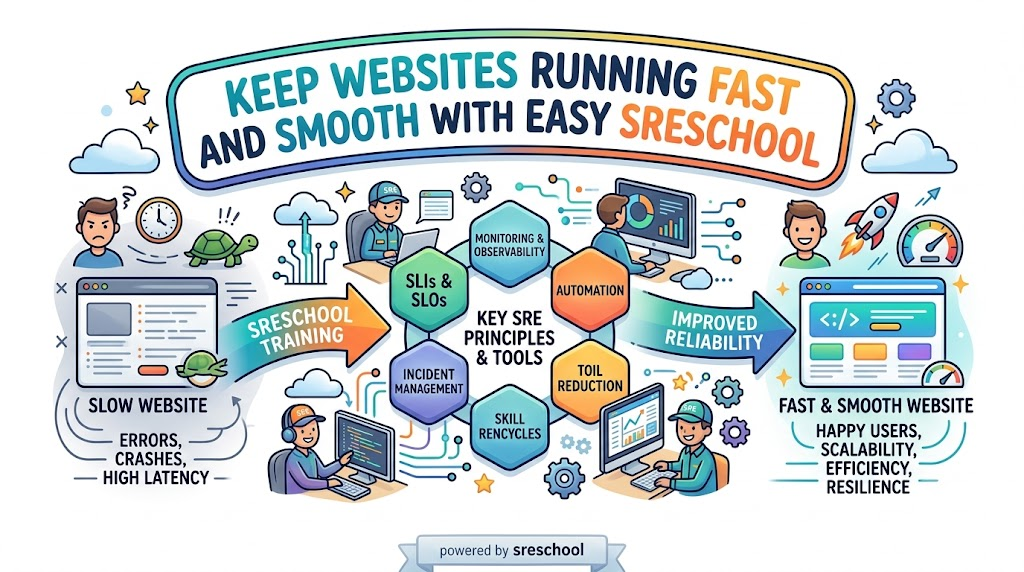
  • Keep Web Apps Running Without Crashes With SRESchool

    Introduction

    Think about your favorite online game suddenly freezing during a big match. Blank screens and loading wheels make players mad.

    Clever tech workers stop these sudden freezes before they ruin your fun. They use a powerful discipline called Site Reliability Engineering.

    This practice makes computers and phone apps run fast and stay strong. It stops servers from crashing when millions of users log in together.

    Anyone can learn these vital skills with easy practice. A hands-on training hub named SRESchool shows learners how to build unbreakable systems.

    What Makes This System Work So Well

    Let us look at how modern teams build better apps. Here are three key rules they follow every day:

    • Measure what matters: Track page load speeds using clear health numbers.
    • Automate dull chores: Build smart software scripts that handle routine maintenance.
    • Plan for surprise errors: Expect computers to glitch and prepare instant backup steps.

    Easy Words That Explain Big Systems

    Tech pros use short terms to describe server health. For example, an SLI acts like a speedometer that measures true website speed.

    Next, an SLO sets a clear goal for that speed. A shopping site might promise to run fast 99% of the time.

    Then, error budgets provide a safe cushion for fun tests. Coders use this wiggle room to roll out cool new features safely.

    Because numbers stay clear, team members never argue about updates. Everyone knows when to move fast and when to fix small errors.

    Build Real Skills With SRE Training

    Reading dry documents puts people right to sleep. Real mastery happens when you fix things with your own two hands.

    Structured SRE Training lets you control safe practice computers. You resolve fake server fires without hurting real users on the web.

    You learn how to spot glowing warning lights on computer screens. Also, you create smart robots that fix broken files all on their own.

    Because practice builds quick confidence, you solve hard puzzles easily. Soon, you can fix giant server hiccups without breaking a sweat.

    Five Steps To Stop A System Emergency

    When a web app breaks, smart engineers follow an easy rescue path:

    1. Spot the red light: Check the monitoring panel to find the broken server.
    2. Alert the crew: Send a quick note so helpful teammates join in.
    3. Turn off broken parts: Disable minor features to protect the main homepage.
    4. Fix bad code lines: Write clean instructions so the crash never returns.
    5. Write down notes: Share what happened so everyone learns from the mishap.

    Learn In A Site Reliability Engineering Course

    Structured classes show you how giant websites operate behind the scenes. A complete Site Reliability Engineering Course guides you through real production platforms.

    Helpful coaches walk you through realistic disaster drills step by step. You discover how to turn off noisy alarms and catch real trouble.

    Next, you install neat sensors that warn you before databases fill up. You learn to launch cool updates while keeping servers safe.

    This practical training turns complex network puzzles into simple ideas. You gain powerful skills that impress tech managers everywhere.

    Explore Quick Lessons In An SRE Tutorial

    Curious beginners can learn great skills at their own pace. A short SRE Tutorial breaks big ideas into quick weekend reads.

    These guides share simple sketches and code samples you can run at home. You never need to untangle messy math formulas.

    Each brief lesson tackles one small puzzle at a time. Next, you connect those pieces to build sturdy cloud systems.

    Because these guides stay short, learning feels like playing a fun game. You boost your tech skills with every page you read.

    Great SRE Tools Every Tech Team Needs

    Modern builders use special software helpers to watch their networks. They run clever SRE Tools that scan servers day and night.

    Some tools watch memory levels and flash warning lights before trouble starts. Other tools simulate safe server crashes to test emergency backup systems.

    Here is a quick look at the top tools in action:

    Tool GroupWhat It Does Every DayWhy It Helps Your Team
    ObservabilityWatches server speed and memory useCatches sneaky bugs before outages occur
    AlertingSends loud notifications during crashesBrings fast help to fix broken web pages
    AutomationRuns boring cleanups on a strict timerStops human mistakes during daily tasks
    Chaos TestingBreaks test systems on purposeCreates tough networks that survive surprises

    How Modern Methods Beat Old Habits

    Old computer workers often waited until things caught fire. Modern engineers prepare for hiccups ahead of time:

    Daily TaskOld Tech HabitsModern Reliability Habits
    Fixing OutagesFixes every crash by handWrites smart programs that heal servers instantly
    Boring ChoresRepeats dull steps manuallyRemoves repetitive work with clever code scripts
    System UptimeHopes machines never breakExpects failure and automates instant recovery
    New UpdatesDelays releases out of fearUses error budgets to launch updates safely

    Earn A Respected SRE Certification

    Showing your skills helps you land exciting jobs. An industry-backed SRE Certification proves your abilities to top employers.

    Tests verify that you know how to trace and fix sudden outages. They check your talent for creating safe rules for busy cloud networks.

    Companies hire certified pros because they protect valuable systems from breaking. A recognized badge shows everyone that you can handle large production platforms.

    Preparing for this test speeds up your career growth. You stand out as an expert who keeps systems running smooth and clean.

    Rise Up As A Certified Site Reliability Engineer

    Reaching this high rank changes your career journey completely. As a Certified Site Reliability Engineer, other builders ask you for helpful advice.

    You build tough cloud setups that survive huge crowds of online holiday shoppers. You teach junior coders how to write clean programs that resist bugs.

    Also, you guide big decisions for apps that millions of people love. Top technology companies value your rare talents and offer great pay.

    Fix Big Bottlenecks With SRE Consulting

    Sometimes a busy company needs outside help to clean up its cloud. Seasoned SRE Consulting solves these hard problems fast.

    Friendly experts look over your entire network layout with care. They track down hidden slowdowns before customers get upset.

    Next, they show managers how to set fair uptime targets. They train your workers to handle sudden alarms calmly and quickly.

    Because these pros have fixed hundreds of outages, they work fast. Your company enjoys smoother operations and happy customers.

    Protect Small Platforms With SRE as a Service

    Small companies rarely have big budgets to hire a full team. They pick SRE as a Service to get top protection on a friendly budget.

    Experienced specialists watch your servers round the clock. You pay only for the exact help your business requires.

    They patch security holes and balance web traffic without slowing down pages. If a server acts up at midnight, they repair it right away.

    This freedom lets your small crew build awesome new products. You grow your business while experts protect your digital home.

    Transform Enterprise Teams With Corporate SRE Training

    Large companies have hundreds of coders who must row in the same direction. Tailored Corporate SRE Training unites whole departments under clear safety habits.

    When software writers and system helpers share the same goals, projects ship smoothly. Coders stop tossing messy code over the fence for other people to fix.

    Instead, everyone shares the job of keeping the platform alive and well. Teams study mistakes calmly without pointing fingers at each other.

    As a result, companies save tons of money on preventable outages. Happy teams create superior products that users truly love.

    Who Should Pick Up These Valuable Skills

    Many bright workers can grow by learning these practices:

    • Software Coders: Write neat programs that handle sudden traffic spikes.
    • Cloud Architects: Construct safe networks that survive power blackouts.
    • System Helpers: Turn boring daily typing tasks into quick automatic scripts.
    • DevOps Leaders: Ship exciting features while keeping server health high.
    • Tech Bosses: Set clear performance targets that make customers smile.

    A Real Victory From The Field

    A growing ticket website used to crash whenever a famous singer dropped concert tickets. Mad music fans walked away, and the website lost thousands of sales.

    The company redesigned its setup using modern reliability rules. They installed smart traffic controllers and set up self-healing server groups.

    During the next mega sale, ticket buyers flooded the site without a single hiccup. Fans bought their tickets in seconds, while the engineering team smiled and relaxed.

    This win proves that good plans beat messy firefighting every single time. Smart planning keeps your favorite websites alive during huge traffic rushes.

    Frequently Asked Questions About sreschool

    Why do so many students join sreschool?

    Learners join because practical labs teach real troubleshooting skills instead of boring slide shows.

    Which jobs benefit the most from these classes?

    Programmers, cloud admins, support workers, and team leads gain direct skills to prevent website crashes.

    Can a total beginner take these courses?

    Yes, because simple words and step-by-step labs explain hard concepts clearly from the very start.

    Can business owners book custom workshops for their workers?

    Companies can request custom training modules crafted around their own private software stacks and tools.

    What practical tools do students test during labs?

    Students use real health dashboards, fast alarm systems, and automated cloud tools used across the tech world.

    Why do tech employers seek out reliability talent?

    Leaders pay top wages to engineers who keep web pages running fast during heavy traffic spikes.

    What is the real purpose of an error budget?

    It acts like a safe cushion that lets builders launch creative features without fear of tiny mistakes.

    Do students fix real computer issues during lessons?

    Every course module features safe practice labs where you fix simulated outages just like true professionals do.

    Can early-stage startups get help without hiring ten full-time workers?

    Small teams can hire flexible on-demand reliability specialists to guard their cloud platforms on a light budget.

    How do students earn an official graduation badge?

    You complete the video modules, solve every hands-on practice lab, and pass the final skill test.

    Moving Forward Toward Unbreakable Systems

    Modern society runs on digital networks, from school portals to money apps and hospital tools. Whenever a core website stops working, real people face real struggles.

    Mastering these easy habits turns you into a digital protector for everyone. You keep vital apps online, fast, and completely safe for millions of users.

    Whether you want to learn independently or hire expert guidance, SRESchool provides the exact steps to build unbreakable systems. Pick up your tools today, and build digital services that everyone can count on!

  • Empowering Industry Professionals to Master Scaled Cloud Systems and DevOps Engineering

    Modern enterprise engineering requires professionals to deliver software rapidly while maintaining absolute infrastructure stability across distributed environments. Consequently, technical teams face immense pressure to replace obsolete deployment practices with automated, resilient delivery workflows. By turning to industry-grade platforms such as DevOpsSchool, aspiring engineers and senior practitioners acquire practical competencies across containerization, continuous delivery pipelines, and cloud orchestration. This structured immersion transforms traditional sysadmins and software developers into confident architects capable of navigating intricate production ecosystems.

    Today, enterprise platforms demand continuous agility rather than sporadic quarterly release cycles. Organizations therefore seek practitioners who understand automated governance, resilient multi-cloud architectures, and zero-downtime release strategies. As technical stacks grow increasingly distributed, engineers who bridge the divide between rapid development and operational resilience become indispensable assets.

    Furthermore, acquiring these skills requires immersive, hands-on experimentation rather than passive theoretical study. When engineers configure real infrastructure environments, debug failing automated builds, and remediate production bottlenecks, they cultivate practical problem-solving capabilities that directly serve enterprise digital transformation initiatives.

    Overcoming the Industry Technical Competency Divide

    Enterprise technology stacks have evolved dramatically over the last decade, leaving many IT departments struggling with critical skill shortages. Consequently, traditional infrastructure teams often struggle to manage declarative cloud platforms and automated testing frameworks.

    Meanwhile, software developers frequently lack deep visibility into container networking, Linux kernel parameters, and production runtime diagnostics. This knowledge asymmetry creates delivery friction, prolonged maintenance windows, and avoidable service interruptions during major releases.

    The Practitioner-Driven Learning Paradigm

    Engineers master distributed systems most effectively when they learn directly from active industry practitioners who manage production systems daily. Therefore, practical mentoring focuses on genuine production architectural designs rather than contrived academic exercises.

    +-------------------------------------------------------------------------+
    |                  Enterprise Competency Acceleration Engine              |
    +-------------------------------------------------------------------------+
    |  Real-World Scenarios   -->  Automated Feedback   -->  Production Labs  |
    |          |                            |                         |       |
    |  Live Troubleshooting         Pipeline Validation      Cloud Staging    |
    +-------------------------------------------------------------------------+
    |  Continuous Mentoring   <--  Architecture Design  <-- Multi-Cloud IaC   |
    +-------------------------------------------------------------------------+
    

    Moreover, hands-on lab environments allow learners to trigger controlled failures safely. By diagnosing split-brain cluster states, broken continuous integration configurations, and network timeouts, engineers develop the composure necessary to manage mission-critical enterprise outages.

    Strategic Skill Pillars for Enterprise Engineering

    • Collaborative Automation: Engineers integrate version control mechanisms with automated validation test suites to accelerate release velocity.
    • Declarative Orchestration: System specialists model container fleets and service meshes using programmatic configuration files.
    • Continuous Security Integration: Platform architects embed static code analysis, vulnerability scanning, and secret management directly inside delivery pipelines.
    • Dynamic Cloud Provisioning: Teams deploy multi-cloud infrastructure dynamically through reusable code templates rather than manual dashboard clicks.

    Key Operational Concepts You Must Know

    Navigating modern infrastructure environments requires a thorough grasp of fundamental architectural principles that govern high-availability distributed systems.

    Version Control and Trunk-Based Delivery

    First, distributed version control serves as the single immutable source of truth for both application logic and infrastructure definitions. Consequently, modern platform teams avoid long-lived feature branches, choosing trunk-based development strategies instead.

    This discipline forces developers to merge incremental updates into a shared mainline branch multiple times per day. As a result, automated integration engines test small increments immediately, which dramatically reduces merge conflicts and identifies regressions early.

    Continuous Integration and Continuous Delivery Frameworks

    Next, continuous integration engines eliminate manual build bottlenecks by compiling code, executing automated test suites, and creating container artifacts automatically. Whenever an engineer submits a pull request, the pipeline triggers rigorous quality gates.

    Furthermore, continuous delivery platforms automate deployment into staging and production clusters via canary or blue-green patterns. Hence, deployment risk drops significantly because teams test application health against real production traffic before completing full rollouts.

    Declarative Infrastructure as Code

    Additionally, provisioning cloud infrastructure through graphical web consoles creates drift, documentation gaps, and security oversights. Conversely, declarative Infrastructure as Code allows teams to define virtual networks, compute instances, and database clusters programmatically.

    +---------------------------------------------------------------------+
    |                      Declarative IaC Lifecycle                      |
    +---------------------------------------------------------------------+
    |  1. Author Template   -->  Version Control Commit (Git)             |
    |  2. Automated Review  -->  Spec Validation & Security Scanning      |
    |  3. Execution Plan    -->  Dry-Run State Diff Verification          |
    |  4. Cloud Apply       -->  Automated Provisioning (Zero Manual GUI) |
    |  5. State Tracking    -->  Continuous Drift Detection & Healing     |
    +---------------------------------------------------------------------+
    

    Consequently, operations teams treat infrastructure templates with the same engineering rigor as application software. Version-controlled repositories store these templates, enabling immediate disaster recovery and identical environment provisioning across multiple geographic cloud regions.

    Deep Observability and Distributed Tracing

    Moreover, modern microservices architectures render traditional server-level monitoring checks obsolete. Instead, engineering teams depend on telemetry pillars consisting of structured metrics, centralized logs, and distributed traces.

    Distributed tracing tracks individual user requests as they traverse dozens of containerized microservices across cloud boundaries. Accordingly, when latency spikes occur, on-call engineers pinpoint the exact failing database query or slow third-party API call within seconds.

    Platform Implementation vs. Culture — What’s the Real Difference?

    Many organizations mistakenly believe that purchasing modern software subscriptions and adopting container platforms automatically guarantees operational success. Nevertheless, technical tooling yields minimal value if organizational habits remain siloed and adversarial.

    Operational DimensionPlatform Implementation (Tools & Code)Cultural Transformation (Mindset & Habits)
    Primary FocusAutomation pipelines, Kubernetes clusters, cloud APIsEmpathy, cross-functional collaboration, psychological safety
    Core DeliverableDeployment manifests, telemetry dashboards, scriptsShared operational ownership, transparent communication, blameless reviews
    Performance MetricPipeline execution speed, deployment frequency, cluster densityMean time to recovery, change failure rate, engineer retention
    Approach to OutagesAutomated failovers, container restarts, threshold alertsRoot-cause analysis, system resilience learning, preventive engineering
    Execution StyleScripted automation and programmatic infrastructureContinuous feedback, collaborative problem solving, proactive support

    The Mechanics of Platform Engineering

    Platform implementation supplies the tangible technical machinery that automates repetitive administrative duties. For instance, platform engineers design internal developer portals that allow product developers to spin up compliant testing environments independently.

    Therefore, automated platforms remove ticketing queues and eliminate administrative gatekeeping. This self-service automation accelerates delivery timelines and frees operations specialists from handling mundane server provisioning requests.

    The Supremacy of Cultural Collaboration

    Nevertheless, organizational culture determines how teams use these automated systems when complex production challenges arise. In a blame-heavy workplace, engineers hide mistakes, postpone releases out of fear, and resist taking ownership of production reliability.

    Conversely, a mature operational culture celebrates transparency and encourages blameless incident post-mortems. When production outages happen, the organization examines systemic architectural flaws rather than punishing individual contributors. Consequently, psychological safety flourishes, driving sustained technical innovation across the entire company.

    Real-World Use Cases of Modern Operations

    Leading global organizations apply these technical workflows to handle demanding scale, stringent compliance mandates, and high-frequency deployment demands.

    FinTech High-Volume Payment Processing

    Financial technology institutions handle millions of transactional updates daily while adhering strictly to international data security mandates. Accordingly, engineering teams embed automated compliance verifications directly inside continuous integration pipelines.

    Before any service artifact deploys to production, security linters scan dependencies for known vulnerabilities, verify cryptographic signatures, and audit access control configurations. Thus, financial platforms deploy feature updates continuously while meeting demanding security governance guidelines.

    E-Commerce Elasticity During Global Flash Sales

    During seasonal sales events, global e-commerce websites experience unpredictable, massive traffic surges. Using horizontal pod autoscalers and dynamic cloud infrastructure groups, these platforms scale microservices dynamically in response to incoming request queues.

    +--------------------------------------------------------------------+
    |                Dynamic Cloud Elasticity Architecture               |
    +--------------------------------------------------------------------+
    |  Incoming Traffic Surge --> Load Balancer Telemetry Evaluator       |
    |                                    |                               |
    |                         Autoscaling Trigger                        |
    |                                    |                               |
    |           +------------------------+------------------------+      |
    |           |                                                 |      |
    |   Worker Pod Replicas Spawn                Cloud Compute Nodes Join|
    |   (Scale: 10 -> 250 Units)                 (Capacity Multiplies)   |
    +--------------------------------------------------------------------+
    

    Furthermore, automated traffic routing channels isolate failing third-party payment gateways smoothly, ensuring the core shopping catalog remains responsive. Hence, digital retailers maintain revenue throughput and deliver responsive user experiences during peak demand.

    Autonomous Fleet Telematics and Edge Computing

    Autonomous mobility platforms collect gigabytes of continuous telemetry from thousands of connected vehicles simultaneously. Operations teams deploy containerized edge computation nodes to parse sensor readings locally before transmitting aggregated summaries back to central cloud repositories.

    Consequently, edge nodes filter out redundant sensor data locally, conserving substantial network bandwidth costs. Meanwhile, centralized infrastructure pipelines push firmware and algorithm updates safely to remote vehicle edge nodes using progressive rollout strategies.

    Common Mistakes in Operations Engineering

    Even highly experienced infrastructure teams occasionally adopt counterproductive practices that create technical debt and destabilize production environments.

    • Treating Infrastructure Code as Ad-Hoc Scripts: Engineers often author shell scripts lacking parameterization, automated linting, or modular structure, creating unmaintainable infrastructure spaghetti.
    • Adopting Overly Complex Stacks Prematurely: Implementing multi-region service meshes and distributed key-value stores for basic applications introduces unneeded operational overhead without clear justification.
    • Neglecting Telemetry and Actionable Alerting: Configuring hundreds of noisy metric alerts causes alert fatigue, leading exhausted engineers to ignore critical production warnings during genuine outages.
    • Postponing Security Validation to Late Release Stages: Isolating security evaluations to the end of development cycles generates friction, triggering severe deployment delays and costly refactoring.
    • Ignoring Cloud FinOps and Resource Optimization: Failing to configure container resource limits and clean up orphaned cloud storage buckets causes runaway monthly cloud infrastructure expenditures.

    How to Become an Operations Expert — Career Roadmap

    Transitioning into an advanced operational engineering role demands a deliberate, progressive learning path covering systems programming, automated infrastructure, and resilience design.

    +-------------------------------------------------------------------------+
    |                  Operations Expertise Mastery Roadmap                   |
    +-------------------------------------------------------------------------+
    |  Tier 1: Foundations     --> Linux Internals, Bash Scripting, Networking|
    |  Tier 2: Versioning & CI --> Git Flow, Pipeline Architecture, Automation|
    |  Tier 3: Containers      --> Docker Packaging, Kubernetes Orchestration |
    |  Tier 4: Cloud & IaC     --> Declarative Provisioning, Multi-Cloud APIs |
    |  Tier 5: SRE & Chaos     --> Observability, SLOs, Chaos Engineering     |
    +-------------------------------------------------------------------------+
    

    Progressive Engineering Milestones

    1. Operating System and Network Fundamentals: Master core Linux system administration concepts, including file permissions, systemd service lifecycle management, kernel performance tuning, and TCP/IP networking primitives.
    2. Automated Continuous Integration Pipelines: Design automated testing pipelines that validate source code, execute security checks, and assemble production-ready binary artifacts automatically upon every commit.
    3. Container Packaging and Cluster Orchestration: Containerize complex multi-tiered applications using optimized container images, then manage clustered workloads using production container orchestrators.
    4. Declarative Cloud Architecture and Policy Enforcement: Construct reusable infrastructure definitions to manage cloud compute, storage, and networking layers programmatically, while enforcing automated policy-as-code guardrails.
    5. Site Reliability Engineering and Fault Injection: Define Service Level Objectives (SLOs) and Error Budgets, and implement proactive chaos engineering tests to validate system self-healing capabilities before catastrophic outages occur.

    Strategic Role Pathways and Focus Areas

    • Cloud Infrastructure Architect: Specializes in multi-cloud network topologies, enterprise identity federation, and automated disaster recovery architectures across hybrid environments.
    • Site Reliability Engineer: Focuses on distributed tracing, automated incident mitigation, platform availability metrics, and proactive failure-injection testing.
    • DevSecOps Specialist: Implements static and dynamic code vulnerability analysis, container runtime security, automated secret management, and regulatory compliance validation.
    • Platform Experience Engineer: Builds internal developer portals, golden deployment paths, and self-service automation tooling to enhance developer productivity across the organization.

    FAQ Section

    1. What foundational competencies should an engineer build before pursuing platform automation?Engineers should first gain practical fluency in Linux operating systems, basic networking protocols, version control workflows using Git, and a scripting language such as Python or Go.
    2. How does platform automation differ from legacy system administration?Legacy systems administrators manage hardware and server installations through manual interventions, whereas modern platform engineers design programmatic software solutions that automate dynamic cloud infrastructure.
    3. Why do organizations emphasize container orchestration over conventional virtual machines?Containers share the host operating system kernel, making them significantly lighter, faster to launch, and more resource-efficient than traditional virtual machines while guaranteeing environment consistency.
    4. What role does Site Reliability Engineering play alongside continuous delivery pipelines?Site Reliability Engineering provides the operational metrics, availability targets, and resilience engineering practices that ensure continuous delivery pipelines release software without degrading production stability.
    5. How can engineering teams prevent cloud cost overruns when adopting automated provisioning?Teams should implement strict resource quotas, configure automated schedule policies for non-production environments, tag all cloud resources systematically, and monitor expenditures using automated FinOps dashboards.
    6. How long does it take for an IT professional to become proficient in modern operational tools?Dedicated engineers typically require six to nine months of consistent, hands-on lab work and project building to acquire production-grade operational proficiency across the entire ecosystem.

    Final Summary

    Modern software delivery demands speed, technical precision, and unbreakable operational stability across complex cloud environments. By mastering version control, continuous integration pipelines, container orchestration, and declarative infrastructure code, technical professionals unlock transformative career growth.

    Furthermore, integrating advanced automation platforms with a healthy, blameless engineering culture ensures organizations innovate rapidly while maintaining superior platform reliability. Immersive, hands-on practice remains the single most effective way to internalize these capabilities. Commit to practical experimentation, build end-to-end delivery systems, and lead the future of modern enterprise engineering.