Tag: #Docker

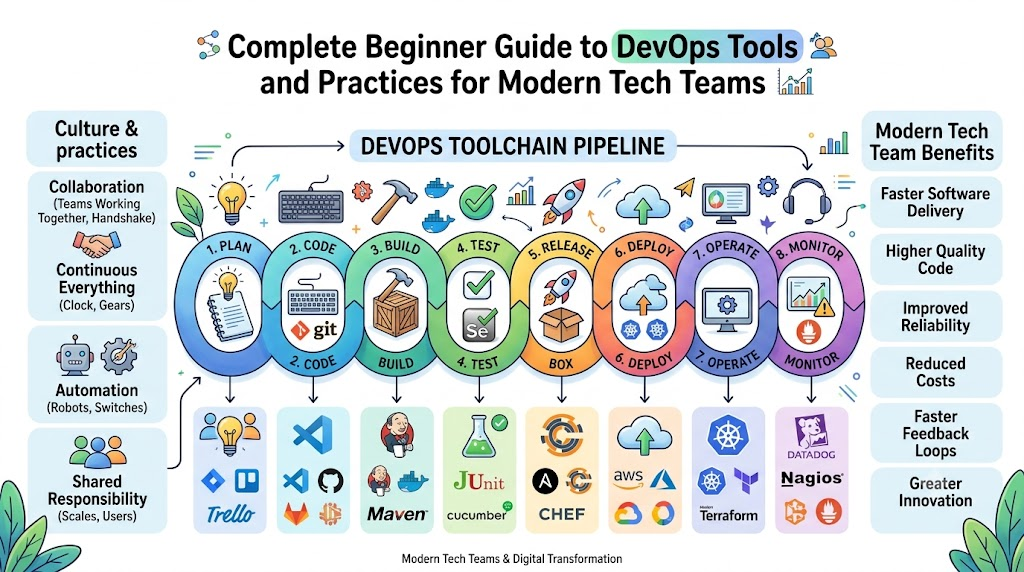
  • Complete Beginner Guide to DevOps Tools and Practices for Modern Tech Teams

    DevOps brings two main computer teams together to build awesome apps. First, developers write code to create new software games and helpful tools. Next, operations helpers run big cloud servers so these apps work smoothly every day.

    You can learn these skills step by step with DevOpsSchool. Their friendly mentors show beginners how to use cool tools to deliver software fast. Therefore, learning these basic steps will help you build, test, and ship your ideas safely!

    devopsschool.cn

    What Is DevOps and Why Do Teams Need It?

    Long ago, coders and server keepers worked in separate rooms. Coders wrote programs and tossed them over a tall wall. Then, the server keepers had to figure out how to run them.

    Because the two teams did not talk, apps broke often. Users got mad because games crashed and took months to update. So, smart workers decided to join forces and work as one happy team.

    Now, DevOps lets teams build and share new computer programs quickly. Everyone shares the work and helps each other fix small mistakes right away.

    +--------------------------------------------------------------------+
    |                      The Simple DevOps Loop                        |
    +--------------------------------------------------------------------+
    |  1. Plan App  -->  2. Write Code  -->  3. Test Program             |
    |       ^                                     |                      |
    |  6. Check Bugs  <--  5. Watch App  <--  4. Ship to Users           |
    +--------------------------------------------------------------------+
    

    Key Operational Concepts You Must Know

    To keep modern software running fast, beginners must learn a few easy ideas.

    The Big Magic Notebook for Code

    First, coders use a system named version control to save their daily work. Think of it like a magical notebook that remembers every single word you write.

    If you make a silly mistake, you can flip back to an older page. As a result, you never lose your work or ruin the whole program.

    • Git: This free tool records every line of code you change.
    • GitHub: This website stores your code online so friends can work together.
    • Branches: These are separate workspaces where you try new ideas safely.

    The Friendly Assembly Line

    Next, teams build an automated assembly line for their software. In tech speak, we call this continuous integration and continuous delivery.

    When you finish writing your code, a robot helper tests it right away. If the robot finds an error, it sends you a message immediately.

    +--------------------------------------------------------------------+
    |                   The Software Assembly Line                       |
    +--------------------------------------------------------------------+
    |  Step 1: Save code to the shared project folder.                   |
    |  Step 2: A robot checks the code for spelling mistakes.            |
    |  Step 3: The robot runs tests to make sure games run fast.         |
    |  Step 4: The system puts the finished game on the web.             |
    +--------------------------------------------------------------------+
    

    Neat Lunchboxes for Software

    Also, modern engineers pack their apps into neat digital boxes called containers. Just like your school lunchbox keeps your sandwich safe, containers hold everything an app needs.

    Because of this, the app runs the same way on your laptop as it does on huge cloud computers. You never have to worry about missing files or broken system settings.

    Platform Implementation vs. Culture — What’s the Real Difference?

    Many companies buy fancy computer programs and expect instant success. But shiny tools alone do not make a great team.

    What We Look AtSetting Up Tools (The Tech Box)Building Culture (The Team Spirit)
    Main GoalSet up robots, servers, and automated pipelines.Help people talk nicely and work together every day.
    Key HelpersCode scripts, dashboards, and cloud storage systems.Friendly chats, team support, and shared goals.
    How to MeasureCount how fast updates reach user phones.Check how much team members trust and help each other.
    When Things BreakRobots restart servers and sound quick warning alarms.The team meets to fix the issue without blaming anyone.

    Tools Are Only Toys Without Teamwork

    You can buy the best soccer ball in the world. But if players never pass the ball, the team will still lose the game.

    Culture means people share goals and help each other learn new tricks. When coders and server helpers trust each other, they solve tough problems fast.

    Real-World Use Cases of Modern Operations

    Many popular apps you use every day rely on modern operations practices.

    Online Video Streaming Services

    Think about your favorite cartoon streaming site on a busy Saturday morning. Millions of kids log in at the very same time to watch new shows.

    Smart systems spot the huge crowd and start up more servers right away. Then, when night comes and kids go to sleep, the extra servers turn off to save money.

    Mobile Game Update Days

    Have you ever played a mobile game that updates every single week? In the past, companies stopped the game for hours to fix bugs.

    Now, teams send small updates to user phones while people play. The new features slip into the game quietly without stopping your fun.

    Bank and Store Websites

    Online stores get very busy during holiday sales events. Shoppers rush to buy toys and shoes before the items sell out.

    DevOps tools test the checkout page thousands of times before the rush begins. So, parents can buy gifts quickly without the shop page freezing up.

    Common Mistakes in Operations Engineering

    Beginners often make a few easy-to-fix mistakes when they start their learning journey.

    • Doing Every Task by Hand: Click-happy workers waste hours clicking buttons when a simple script can do the job.
    • Buying Too Many Tools at Once: Using ten complex tools on day one confuses everyone and slows down the work.
    • Forgetting to Test Early: Skipping quick tests lets nasty bugs sneak directly onto user screens.
    • Blaming People for Mistakes: Pointing fingers hurts feelings and stops people from speaking up when things break.
    • Ignoring System Alarms: Turning off warning bells means you will not notice when your app runs out of memory.

    How to Become an Operations Expert — Career Roadmap

    You can grow from a curious beginner into an expert engineer with steady practice.

    Step 1: Learn Basic Computer Commands

    First, learn how to talk to computers using simple text commands. Linux is the operating system that runs most of the internet today.

    So, practice typing short words to make folders, move files, and read system notes. Once you feel comfortable typing commands, you can manage any big server.

    Step 2: Pick Up a Simple Code Language

    Next, learn a beginner-friendly programming language like Python. Python reads almost like plain English books.

    You can write short scripts to do your daily chores automatically. For example, your script can back up your files every day at dinner time.

    +--------------------------------------------------------------------+
    |                      Your Friendly Learning Steps                  |
    +--------------------------------------------------------------------+
    |  Level 1: Master Linux commands and Git file saving.               |
    |  Level 2: Write small Python scripts to do simple chores.          |
    |  Level 3: Pack apps inside Docker containers.                      |
    |  Level 4: Run apps on cloud servers like AWS or Google Cloud.      |
    |  Level 5: Set up watchtower alerts to catch broken parts fast.     |
    +--------------------------------------------------------------------+
    

    Step 3: Pack Apps and Send Them to the Cloud

    After you learn basic code, start playing with container tools like Docker. Build a small website and pack it into a digital container.

    Next, rent a tiny cloud server online and launch your container there. You will feel proud when your friends open your website on their phones!

    FAQ Section

    1. Do I need to be a math genius to learn these tools?No, you do not need hard math skills to work with these tools. You only need to think clearly, solve puzzles, and follow simple step-by-step instructions.
    2. What is the first computer tool I should install on my laptop?You should install Git first because it teaches you how to save and track your work. It protects your practice projects from getting lost or accidentally deleted.
    3. How is a container different from a regular computer program?A regular program needs specific software pieces already installed on your machine to work. A container carries all its own pieces inside, so it runs anywhere without extra setup.
    4. Can I practice these tools for free at home?Yes, almost all core tools like Linux, Git, and Docker are completely free to download. Many cloud companies also offer free practice accounts for new learners.
    5. How long will it take to build my first software pipeline?Most new students can build their first simple automated pipeline in just a few weeks. Taking friendly classes helps you practice the right steps quickly and safely.

    Final Summary

    Modern software delivery works best when people team up and use smart tools. By saving code with Git, packing apps into containers, and running automatic tests, you can build reliable platforms.

    Always remember that working kindly with your team matters just as much as learning complex tools. Keep practicing your steps every day, stay curious, and enjoy building the next generation of amazing computer apps!

  • Complete Guide to DevOps Training for Modern Engineers in Enterprise Tech

    Modern software delivery demands speed, stability, and seamless collaboration between software developers and IT operations teams. Therefore, mastering end-to-end automation pipelines has become essential for anyone looking to scale enterprise platforms reliably. Enrolling in structured programs through DevOpsSchool provides professionals with hands-on exposure to industry-standard toolchains, real-time debugging workflows, and cloud infrastructure management. Consequently, engineers transition from basic scripting tasks to leading multi-cloud architecture projects with confidence.

    Modern engineering environments no longer tolerate siloed teams, manual server deployments, or fragmented communication channels. Instead, cross-functional engineering teams manage platform lifecycles through automated delivery systems, containerized clusters, and continuous feedback loops. Thus, technical teams improve product delivery velocity while maintaining zero-downtime availability for critical user services.

    Furthermore, adopting unified operational workflows reduces production incident resolution times significantly. When engineers learn to integrate security, cloud orchestration, and automated testing into their daily work, product quality increases dramatically across every release cycle.

    Understanding Modern Engineering Methodologies and Architecture

    Engineering teams often struggle with slow deployments when they maintain manual handoffs between development and infrastructure management. However, adopting unified operational methodologies bridges this operational gap by standardizing code integration, automated testing, and dynamic infrastructure provisioning into a single, cohesive lifecycle.

    Consequently, developers write code while operations specialists define the runtime environments programmatically. This collaborative integration ensures fast feedback loops, early defect detection, and reliable rollouts across hybrid enterprise environments.

    Core Architectural Foundations

    +-------------------------------------------------------------------+
    |                        Unified Pipeline Lifecycle                 |
    +-------------------------------------------------------------------+
    |  Plan & Code  -->  Continuous Integration  -->  Continuous Deploy |
    |       |                     |                          |          |
    |  Git Versioning       Automated Testing         Container Rollout |
    +-------------------------------------------------------------------+
    |  Operate & Monitor  <--  Infrastructure as Code  <--  Secure Build|
    +-------------------------------------------------------------------+
    

    Essential Competency Breakdown

    • Continuous Integration: Developers commit code changes frequently to a shared repository, which automatically triggers build scripts and comprehensive unit tests.
    • Continuous Delivery and Deployment: Automated staging systems package, validate, and push production-ready artifacts to target runtime clusters seamlessly.
    • Infrastructure as Code: System engineers define cloud networks, storage volumes, and server clusters using version-controlled configuration templates.
    • Observability and Monitoring: Distributed tracing, centralized log aggregation, and real-time metric tracking detect performance bottlenecks before users experience service degradation.

    Key Operational Concepts You Must Know

    To manage modern production infrastructure effectively, engineers must understand core operational primitives that govern high-availability distributed systems.

    Version Control and Distributed Repositories

    First, distributed version control serves as the absolute source of truth for application logic, runtime configuration, and platform orchestration scripts. Modern teams maintain branching strategies, such as trunk-based development, to prevent code drift and simplify concurrent feature releases.

    Moreover, version-controlled repositories enable instant rollbacks during platform outages. As a result, operations teams restore stable configurations within seconds by reverting misconfigured commits directly in the repository history.

    Continuous Integration and Automated Delivery Pipelines

    Next, continuous integration engines eliminate painful manual code merges by validating every pull request automatically. When automated suites execute unit tests, static code analysis, and artifact generation, regressions get blocked before hitting staging environments.

    In addition, continuous delivery pipelines deploy validated software packages into testing and production environments without manual intervention. This reliable flow minimizes human error and guarantees consistent deployment standards across every environment.

    Immutable Infrastructure and Container Orchestration

    Furthermore, containerization packages application dependencies, binaries, and system libraries into lightweight, reproducible execution units. Containers eliminate the classic runtime mismatch where software works on local machines but fails in production clusters.

    Meanwhile, orchestration engines schedule, scale, and heal containerized workloads dynamically across server fleets. Consequently, platforms handle sudden traffic spikes automatically by launching additional container replicas without manual administration.

    Platform Implementation vs. Culture — What’s the Real Difference?

    Organizations often mistake buying modern cloud tools for achieving operational excellence. However, tools alone cannot fix broken organizational workflows or eliminate team friction.

    DimensionPlatform Implementation (Tooling)Cultural Transformation (People & Mindset)
    Primary FocusAutomation pipelines, cloud platforms, container enginesCollaborative ownership, psychological safety, transparent communication
    Key DeliverablesScripts, dashboards, deployment pipelines, infrastructure templatesShared operational responsibility, blameless reviews, continuous learning
    Measurement MetricsDeployment frequency, lead time for changes, server uptimeMean time to recover, team trust scores, cross-functional agility
    Failure ResponseTriggering alerts, spinning up backup instances automaticallyConducting blameless post-mortems, identifying root systemic causes

    The Power of Cultural Transformation

    Adopting automation platforms provides immediate tactical efficiency, yet establishing a collaborative culture drives long-term organizational success. When teams share operational accountability, developers proactively write resilient code because they understand production deployment constraints.

    Similarly, operations engineers assist product developers early in the development lifecycle by provisioning standardized self-service developer environments. Therefore, technical teams reduce delivery friction and eliminate long-standing departmental rivalries.

    Real-World Use Cases of Modern Operations

    Enterprise organizations across diverse business sectors rely on modern operational engineering practices to stay competitive and secure.

    High-Frequency Financial Trading Platforms

    Financial institutions manage strict regulatory compliance requirements while processing millions of transactions per second. Consequently, financial engineering teams implement automated compliance checking directly inside their deployment pipelines.

    Every code change undergoes automated vulnerability scanning, access-control auditing, and unit testing before reaching production clusters. As a result, banks release secure features rapidly while satisfying demanding regulatory oversight mandates.

    Global E-Commerce Platforms During Peak Traffic Events

    During major shopping holidays, global retail platforms experience massive surges in user traffic. By leveraging dynamic container orchestration and auto-scaling policies, these platforms scale server capacity up and down based on real-time consumer demand.

    Furthermore, automated canary deployments allow engineering teams to test new checkout algorithms on small user cohorts safely. Thus, technical teams release new promotional tools during live sales events without risking sitewide downtime.

    Streaming Media Services Handling Distributed Content Delivery

    Global streaming networks distribute petabytes of video data daily to millions of concurrent connected devices. These organizations deploy continuous telemetry collectors and real-time observability dashboards to track edge network performance.

    When regional connection latencies spike, automated routing systems shift network traffic to healthy edge servers instantly. Therefore, global viewers enjoy uninterrupted streaming quality without noticing underlying infrastructure adjustments.

    Common Mistakes in Operations Engineering

    Even experienced engineering teams encounter operational pitfalls when modernizing their infrastructure architectures.

    • Treating Automation Scripts as Throwaway Assets: Teams frequently write shell scripts without version control, modular structures, or unit tests, creating technical debt.
    • Over-Engineering Toolchains Too Early: Adopting complex multi-cloud orchestration platforms before standardizing basic container builds introduces needless operational complexity.
    • Ignoring Observability and Distributed Tracing: Focusing entirely on deployment pipelines while neglecting centralized logging makes troubleshooting live production outages nearly impossible.
    • Siloing Security into an Isolated Stage: Postponing vulnerability assessments until late deployment stages causes severe release delays and leaves infrastructure vulnerable.
    • Neglecting Blameless Post-Mortems: Blaming individual engineers for production failures destroys team psychological safety and hides systemic architectural flaws.

    How to Become an Operations Expert — Career Roadmap

    Transitioning into an advanced operational engineering role requires a clear, structured learning strategy across software development, systems administration, and cloud architecture.

    +--------------------------------------------------------------------+
    |                      Operations Career Roadmap                     |
    +--------------------------------------------------------------------+
    |  Phase 1: Foundations   --> Linux, Bash, Git, Networking           |
    |  Phase 2: Automation    --> CI/CD Pipelines, Python, Scripting     |
    |  Phase 3: Containers    --> Docker, Kubernetes, Service Meshes     |
    |  Phase 4: Cloud & IaC   --> Terraform, Multi-Cloud Orchestration   |
    |  Phase 5: Observability --> Prometheus, Grafana, Distributed Tracing|
    +--------------------------------------------------------------------+
    

    Structured Career Progression Milestones

    1. System Administration and Networking Fundamentals: Master Linux distributions, shell scripting, process scheduling, memory diagnostics, DNS configuration, and TCP/IP networking models.
    2. Version Control and Pipeline Automation: Build end-to-end continuous integration pipelines using modern automation engines to compile code, run test suites, and produce versioned binaries.
    3. Containerization and Orchestration: Package multi-tier microservice architectures into optimized container images and manage production deployments using container orchestration systems.
    4. Declarative Infrastructure Management: Write modular Infrastructure as Code templates to provision virtual networks, database instances, and load balancers programmatically.
    5. Observability, Site Reliability, and Chaos Engineering: Implement metric dashboards, distributed tracing collectors, alerting policies, and proactive fault-injection testing to build resilient platforms.

    FAQ Section

    1. What technical prerequisites do I need before starting this learning path?You should understand basic command-line navigation, fundamental networking concepts, and at least one programming or scripting language, such as Python or Bash.
    2. How does an operations engineer differ from a traditional systems administrator?Systems administrators traditionally manage physical hardware and manual configurations, whereas modern operations engineers write software code to automate dynamic cloud infrastructure.
    3. Which scripting language should aspiring platform engineers learn first?Python and Go remain the most effective languages to learn because enterprise tools, cloud APIs, and container platforms integrate natively with their ecosystems.
    4. Is continuous deployment safe for enterprise organizations with strict compliance standards?Yes, continuous deployment incorporates automated compliance scanning, static security analysis, and policy-as-code validations directly into the pipeline to enforce compliance continuously.
    5. How long does it take to gain production-ready operations engineering skills?Most engineers require between six to nine months of consistent, hands-on project work to master containerization, infrastructure provisioning, and continuous delivery systems.

    Final Summary

    Modern software delivery relies heavily on automation, cross-functional collaboration, and resilient cloud architectures. By mastering continuous integration pipelines, container orchestration, and infrastructure as code, engineers empower organizations to ship high-quality features rapidly.

    Furthermore, combining modern platform tooling with a blameless culture creates high-performing technical teams capable of scaling enterprise platforms reliably. Embracing continuous learning and adopting practical hands-on labs ensures you remain competitive, adaptable, and successful throughout your engineering career.