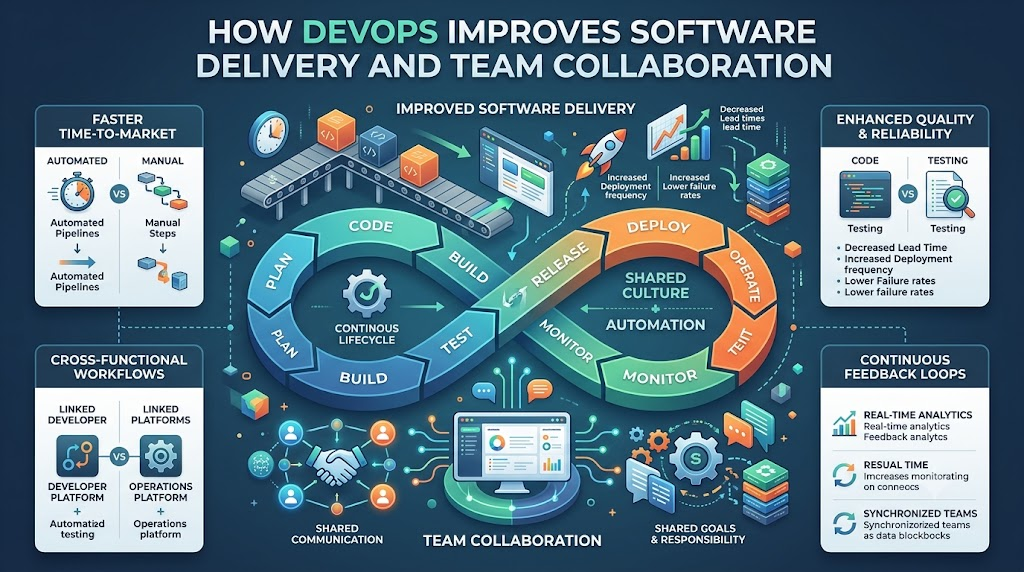
Software delivery used to feel like an endless game of telephone. One group wrote code, while another group tried to run it on servers.
Consequently, projects moved slowly, systems broke often, and teams blamed each other. If you want to learn these essential modern skills, DevOpsSchool provides hands-on training programs that guide engineers step by step.
Modern software engineering replaces that old wall of confusion with shared goals. As a result, teams release great apps faster and work together like a championship sports crew.
What Is DevOps in Everyday Words?
DevOps connects software development with IT operations. Development means creating features, writing code, and designing app interfaces. Operations means managing cloud networks, keeping servers running, and stopping platform crashes.
When both groups unite, work moves much faster. Programmers no longer throw unfinished code over a wall. Instead, both teams talk every single day and solve bugs early.
Furthermore, everyone shares ownership of the final product. Developers learn how their code behaves on real machines. Meanwhile, operations specialists help developers ship updates without breaking live systems.
+------------------------------------------------------------------+
|                     The Unified DevOps Flow                      |
+------------------------------------------------------------------+
|  Plan Features  -->  Write Clean Code  -->  Run Auto Tests       |
|        ^                                           |             |
|        |                                           v             |
|  Share Feedback  <--  Monitor Live Apps  <--  Ship Update        |
+------------------------------------------------------------------+
The Big Problems of Old-Fashioned Workflows
In traditional setups, teams worked inside isolated silos. Developers cared only about writing brand-new features quickly. Meanwhile, operations teams cared only about keeping servers steady and safe.
Because their goals clashed, tension grew constantly. Developers complained when operations delayed new releases. At the same time, operations complained when new code caused painful outages.
- Slow release cycles: Companies waited months or years to launch single software updates.
- Manual deployment mistakes: Workers typed complex commands by hand, causing accidental typos and broken services.
- Finger-pointing games: When an app failed, workers blamed each other instead of solving problems.
- Burnout and late-night calls: Engineers spent weekends fixing sudden production emergencies.
Key Operational Concepts You Must Know
Modern engineering teams use a few simple principles to keep their work smooth, predictable, and error-free.
Version Control and Branching
First, version control acts like a time machine for your project files. Every engineer saves changes to a central repository with clear update notes.
If an error appears, the team rolls back to a safe point instantly. Moreover, team members work on separate branches without overwriting each other’s work.
Continuous Integration and Automated Testing
Next, continuous integration tests code changes the moment an engineer saves them. Automated bots build the whole project and execute safety checks immediately.
When a bug pops up, the bot notifies the author right away. Because errors get caught within minutes, bad code never reaches live user screens.
Continuous Delivery and Fast Shipments
In addition, continuous delivery packages validated code into ready-to-run releases automatically. The pipeline tests each build across test environments that mimic live platforms.
Therefore, releasing new software becomes a routine, low-risk event. Teams can push updates to customers multiple times a day with complete confidence.
Platform Implementation vs. Culture — What’s the Real Difference?
Many organizations buy expensive automation tools and expect instant miracles. However, tools alone cannot repair broken workplace relationships.
| Comparison Area | Platform Implementation (The Machinery) | Culture (The Team Spirit) |
|---|---|---|
| Main Focus | Cloud servers, script bots, and test tools | Empathy, open communication, and trust |
| Everyday Task | Building pipelines and tracking CPU metrics | Sharing lessons and helping teammates |
| Biggest Benefit | Eliminating repetitive, boring manual tasks | Creating a fearless, creative work room |
| Handling Outages | Alerts trigger automated recovery actions | Teams conduct blameless post-mortems |
Building a Safe and Honest Team Culture
Automation platforms provide the engine, but human culture provides the driver. When leaders remove fear, engineers report defects early instead of hiding them.
Similarly, blameless post-mortems focus on fixing fragile systems rather than punishing individuals. This honest mindset builds strong trust across the entire technical team.
Real-World Use Cases of Modern Operations
Leading organizations depend on these unified practices to keep their critical systems online around the clock.
Online Banking Platforms
Banks process millions of sensitive financial transactions every single hour. Therefore, security checks run directly inside their automated delivery pipelines.
Every code update gets scanned for safety vulnerabilities before hitting production. As a result, customers enjoy safe mobile banking without service interruptions.
Video Streaming Services
Streaming platforms experience huge viewer spikes during major sporting events. Automated systems watch server memory and launch extra cloud capacity in seconds.
When the big game concludes, the platform shuts down unused machines automatically. Consequently, streaming companies save money while preventing embarrassing buffer screens.
Ride-Sharing and Map Navigation
Ride-sharing applications push route improvements and pricing updates continuously. By using gradual rollouts, engineers test updates on small groups of drivers first.
If navigation remains accurate, the system releases the update globally. This careful deployment prevents citywide driver confusion.
Common Mistakes in Operations Engineering
Even smart teams fall into common traps when trying to modernize their workflows.
- Treating tools as a magic silver bullet: Buying top-tier software will not fix poor team communication.
- Skipping automated tests: Rushing deployments without automated tests sends hidden defects straight to customers.
- Ignoring telemetry and system logs: Deploying code without monitoring leaves engineers blind during live outages.
- Creating a separate DevOps silo: Handing all automation duties to an isolated team recreates the same old bottlenecks.
- Automating broken processes: Writing scripts for inefficient manual steps only speeds up bad habits.
How to Become an Operations Expert — Career Roadmap
You can master modern delivery practices by following a clear, step-by-step learning progression.
+--------------------------------------------------------------------+
|                       Career Learning Milestones                   |
+--------------------------------------------------------------------+
|  Phase 1: Foundations     --> Linux Terminal, Git, Shell Scripts   |
|  Phase 2: Pipelines       --> CI/CD Automation, Testing Frameworks |
|  Phase 3: Containers      --> Docker Packaging, Kubernetes Clusters|
|  Phase 4: Cloud & IaC     --> Cloud Infrastructure, Terraform      |
|  Phase 5: Observability   --> System Telemetry, Metrics, Tracing   |
+--------------------------------------------------------------------+
1. Master System Basics and Git
Start by learning how to use the Linux command line. Practice navigating file trees, changing permissions, and tracking your project history using Git.
2. Build Automated Pipelines
Next, configure automated build systems that compile code and run unit tests. Understanding basic automation helps you eliminate tedious manual deployment tasks.
3. Package Apps inside Containers
Learn how to wrap applications and their dependencies inside tidy container units. Containers ensure that software behaves the exact same way on your laptop and on cloud servers.
4. Manage Infrastructure as Code
Discover how to build cloud servers, storage disks, and firewalls by writing simple text files. Managing infrastructure like software code prevents configuration drift across enterprise teams.
5. Add Live Monitoring and Telemetry
Finally, connect your running applications to real-time metric dashboards and alert systems. Watching live system health helps you identify performance bottlenecks before users ever notice them.
FAQ Section
- How does DevOps make software delivery faster?It replaces slow manual steps with automated pipelines that test, build, and deploy code updates within minutes.
- Does adopting these practices require learning to code?Yes, engineers need basic scripting skills in languages like Python or Bash to automate daily server tasks.
- How does team collaboration improve under this model?Shared goals, transparent communication, and blameless post-mortems eliminate finger-pointing between developers and operations staff.
- Is continuous delivery safe for critical production systems?Yes, automated tests and gradual canary rollouts catch defects early, making updates much safer than giant, risky releases.
- How can small teams start using these methods?Start small by storing all project files in Git and automating a single repetitive testing step.
Final Summary
DevOps bridges the divide between software creation and system stability. By combining automated delivery pipelines with an open, collaborative culture, technical teams deliver robust features with incredible speed.
Furthermore, replacing tedious manual tasks with smart automation frees engineers to focus on creative problem-solving. Embracing shared accountability and continuous learning will keep your team resilient, fast, and ready for any challenge.